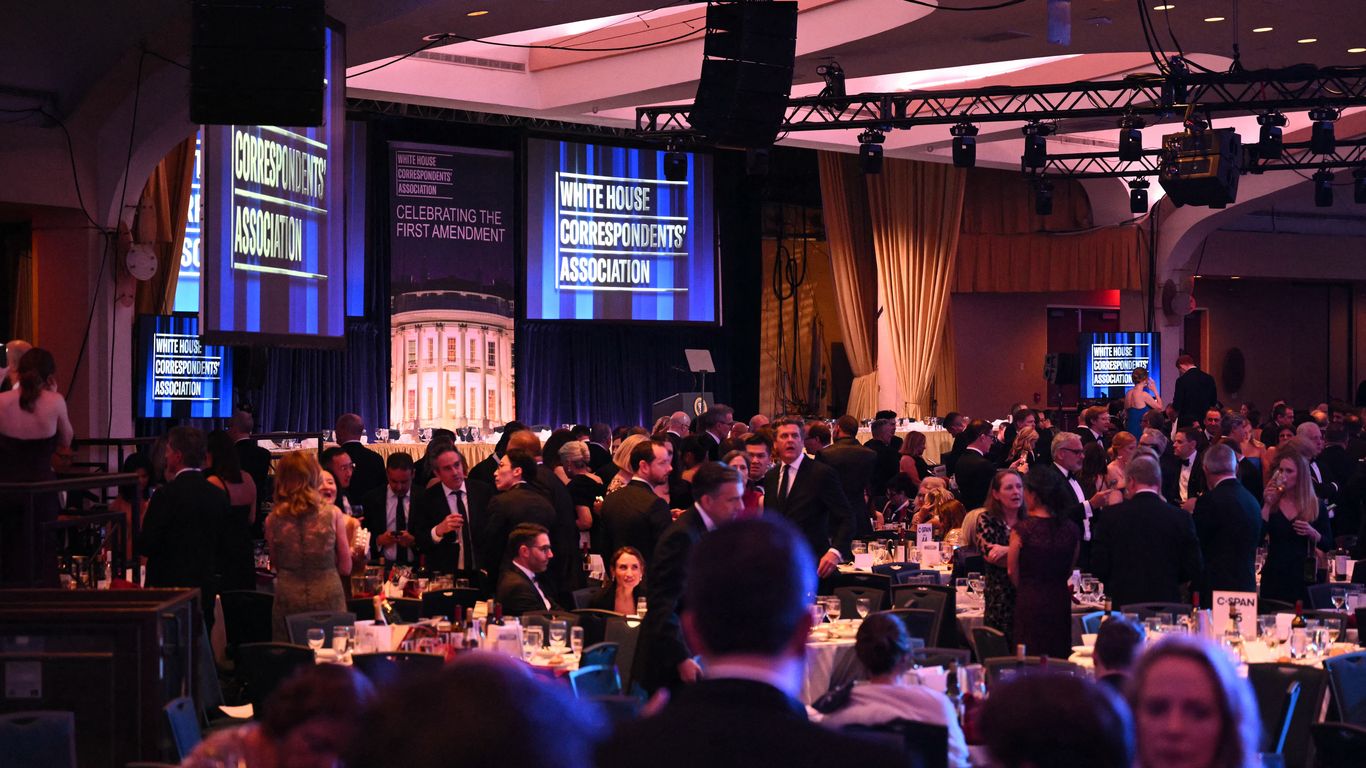
In the past seventy-two hours, the nation has experienced what can only be described as a near-miss with a catastrophe that could have rewritten recent American history. A 31-year-old California teacher named Cole Tomas Allen traveled across the country with a manifesto, a shotgun, a handgun, and multiple knives, all with the explicit intention of targeting members of the Trump administration gathered at one of Washington's most prominent social occasions. That he failed—that the system, in the words of Acting Attorney General Todd Blanche, "worked"—is a fact worth celebrating. Yet the very circumstances that made this failure possible also illuminate a democracy increasingly besieged by violence and the ideological fever dreams that spawn it.
The details are now familiar enough. Allen checked into the hotel on Friday, armed himself with lethal intention, and opened fire outside the ballroom before law enforcement could prevent him from breaching the perimeter. President Trump was hastily evacuated. The Secret Service and Metropolitan Police responded with the precision their training demands. No guests were killed. The machinery of executive protection functioned as designed. By Sunday morning, the official narrative had crystallized around a single reassuring refrain: the system worked. But this framing, however technically accurate, obscures what the incident truly reveals about the state of American political life in 2026.
Allen's alleged manifesto, with its careful prioritization of targets "from highest-ranking to lowest," speaks to something darker than the isolated delusions of a troubled individual. It speaks to the normalization of political violence as a comprehensible response to ideological grievance. That a schoolteacher in California could believe that traveling across the country to assassinate government officials represented a coherent course of action—that he could document this belief in writing, acquire the necessary weapons, and act upon his convictions—suggests that the fever has metastasized beyond a fever.
When Security Becomes Political Theater
The most curious response to Saturday's attack has come not from law enforcement, but from Senate Republicans. Led by Senator Lindsey Graham, a faction of GOP lawmakers has introduced legislation to fund the construction of a $400 million secure ballroom at the White House—a 90,000-square-foot fortress within the People's House itself. The architects of this proposal frame it as essential to national security. To observe it dispassionately, however, is to recognize it as something else entirely: a spectacular gesture toward security that risks becoming security theater on an unprecedented scale.
This is not to dismiss the legitimate concerns that motivated the legislation. Saturday's attack was real, the danger was real, and the failure to prevent the shooter's entry into the hotel—however contained that failure ultimately proved—deserves serious examination. But the impulse to respond by building a fortified ballroom at taxpayer expense, a secure enclave where the nation's most powerful figures can gather behind walls and checkpoints, carries its own symbolic weight. It is the architecture of a political class increasingly afraid of the population it governs.
Consider what it means, structurally and symbolically, to require a separate, heavily secured ballroom for the President and his officials to mingle with journalists and celebrities. The White House Correspondents' Association dinner has long served a particular democratic function: it is a space where the powerful and the press meet on relatively equal social footing, where the president makes self-deprecating jokes and journalists ask difficult questions, where the pretense of absolute separation dissolves into something more familiar and human. To eliminate that space in favor of a fortified alternative is to concede that such democratic mixing has become too dangerous to permit. It is surrender dressed in the language of security.
The Long Shadow of Political Extremism
Yet the real story here is not about ballrooms or security measures, but about the ambient extremism that has made such measures seem necessary. Over the past several years, this country has witnessed a troubling escalation in the rhetoric and reality of political violence. Assassination attempts, mass shootings, plots uncovered and foiled, manifestos distributed. The attempts on President Trump's life in Butler, Pennsylvania and elsewhere are well documented. But what Saturday's incident clarifies is that this violence is not confined to a single political tendency or target set. The impulse to resolve political disagreement through lethal force has calcified into something approaching a permanent feature of American life.
Allen's targeting of Trump administration officials does not negate the reality of threats against other political figures. It simply expands the circle of vulnerability. What we are witnessing is the development of a political culture in which extremist rhetoric—the language of existential threat, of moral absolutes, of enemies who must be stopped by any means necessary—has sufficient cultural circulation that a troubled schoolteacher in California can internalize it as justification for murder.
This is where the coverage of Saturday's shooting becomes instructive precisely in what it leaves unexamined. The mainstream narrative has emphasized the competence of law enforcement, the success of the security protocols, the swift apprehension of the suspect. These are factually true and worth noting. But they have overshadowed the more uncomfortable question: what is a democracy to do when a significant portion of its citizens has internalized the premise that political violence is justified? You cannot arrest your way out of that problem. No ballroom, no matter how secure, can protect against the ideological conditions that produce would-be assassins.
The Institutional Fractures Beneath
One detail from the weekend's events deserves more attention than it has received. President Trump, in his Fox News interview, admitted that he "wasn't making it that easy" for the Secret Service agents at first because he "wanted to see what was going on." Here we see, in miniature, the perennial tension between executive autonomy and executive protection—between a president's desire to remain visible and accessible to the public and the security apparatus's imperative to minimize risk. Trump's account suggests he recognized something was amiss and then, belatedly, deferred to the professionals responsible for keeping him alive.
This is worth remarking upon because it illustrates a truth that extends beyond Saturday's incident. A functioning security apparatus requires cooperation from the principal being protected. It requires a president—or any high official—willing to accept constraints on their own movement and visibility in the service of collective safety. This willingness cannot be taken for granted. And when the political culture has become sufficiently polarized, when the threat environment has become sufficiently acute, the very measures necessary to prevent tragedy become symbols of the disease they are meant to cure.
What Comes Next
The immediate aftermath of Saturday's shooting will likely produce a flurry of legislative activity, security reviews, and political posturing. Some of this will be necessary and constructive. Other aspects will amount to expensive symbolism. But the deeper challenge facing American democracy cannot be resolved through such mechanisms. The threat is not primarily architectural or procedural. It is ideological and cultural.
A nation that has arrived at the point where political assassination seems to a non-negligible subset of its citizens like a comprehensible response to disagreement with those in power has arrived at a dangerous place. The security apparatus can prevent the most determined attacks, can maintain the perimeter, can ensure that the ballroom remains secure. But it cannot restore the presumption of legitimacy that allows a democracy to function without requiring every public gathering of officials to occur behind walls and under guard.
That the system worked on Saturday is worth acknowledging. But it should also prompt the harder question: if the system requires a $400 million fortified ballroom, in what meaningful sense can we say that it is working?