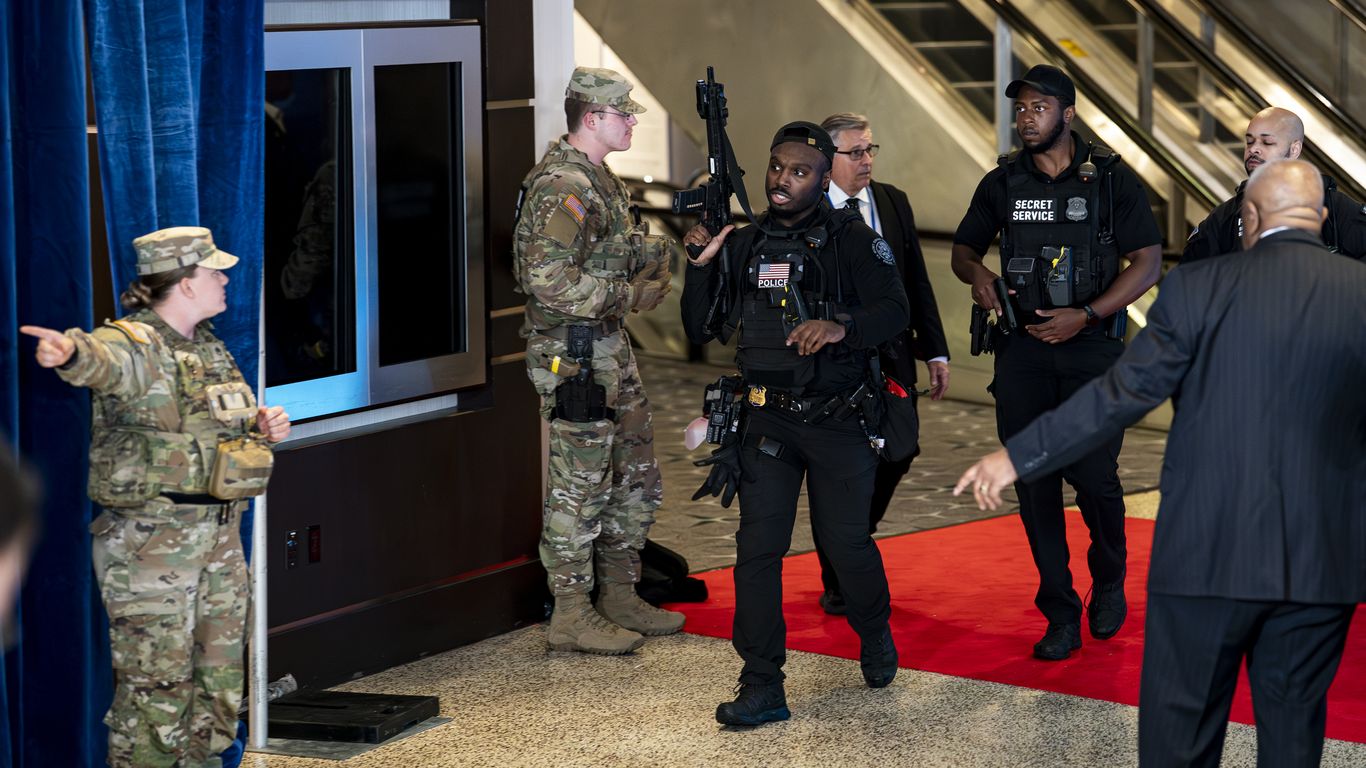
There is a peculiar relief embedded in the language that officials used to describe Saturday night's shooting at the White House Correspondents' Association dinner. Acting Attorney General Todd Blanche declared, in tones of genuine satisfaction, that "the system worked." The Secret Service had done its job. A 31-year-old teacher from California named Cole Tomas Allen, armed with multiple firearms and knives, had been stopped before he could breach the secure perimeter. President Trump was evacuated safely. No one died. By the calculus of modern American political life, this was a victory.
Yet something unsettling lurks beneath this narrative of competent response. We have arrived at a moment where the successful prevention of an assassination attempt at a major national event counts as good news—not because security failures represent genuine negligence, but because political violence aimed at sitting presidents and cabinet officials has become sufficiently common that we now measure success in survivals rather than absences. The fact that Allen traveled by train from California to Washington, checked into the hotel where the nation's power structure would gather, carried a manifesto prioritizing targets "from highest-ranking to lowest," and still was thwarted only underscores how close these incidents have become to succeeding. Three months ago, there was the Butler, Pennsylvania shooting. Before that, countless threats. Now this. The pattern is no longer anomalous; it is becoming the texture of American politics.
The coverage of Saturday's shooting, scattered across the political spectrum from Washington Times to Axios, reveals how thoroughly this normalization has progressed. Lawmakers described being "shaken" and "disturbed," reasonable responses to gunfire at a major event. Several called for improved security protocols. But the discourse never quite escalated beyond procedural concern. No one seriously questioned whether a nation in which armed men repeatedly attempt to assassinate its leaders has a deeper structural problem. No one asked whether the manifesto itself—a document outlining ranked targets for murder—might warrant something more than an investigation of how Allen purchased his firearms.
The Gun Question That Dare Not Speak Its Name
Blanche's response to inevitable questions about gun access has been unambiguous: now is not the time to discuss gun laws. This position, as Axios noted, represents a sharp reversal from the Trump administration's recent willingness to suggest restrictions following the Minneapolis ICE shooting three months earlier—a pivot that provoked such fierce backlash from the president's base that it became, briefly, a serious political liability.
What makes this stance remarkable is not its conservatism on Second Amendment questions, which has deep historical roots, but rather its frank acknowledgment of the political calculus involved. Blanche did not argue that Allen's weapons were illegally obtained; he acknowledged they were purchased legally over the past couple years. He did not contest that Allen used trains as a deliberate workaround to avoid airport security screening; he simply suggested that closing such a loophole would constitute "changing laws," and therefore was not something "we should be focused on right now in any way, shape or form."
The phrase "right now" carries the weight here. It suggests a tactical pause rather than a principled position. One might ask: if not now—after a man with a manifesto targeting federal officials nearly reaches them at a major national gathering—when exactly would "now" be? The answer, of course, is never. There will always be another reason: the political exhaustion following an attack, the need to respect law enforcement investigations, the fear of appearing reactive, the certainty that raising gun access will trigger the base in ways that manifest in midterm polling. The result is a kind of institutional learned helplessness, where the nation's political leadership has implicitly accepted that certain types of violence will simply continue, managed through security protocols and Secret Service capability rather than prevented through policy.
Redistricting in the Shadow of Violence
Meanwhile, in the margins of coverage, Florida's special legislative session beginning Tuesday proceeds with plans to redraw congressional districts—a routine exercise in democratic machinery that has become anything but routine. The Hill reports that uncertainty about potential legal challenges has left incumbents and candidates in genuine limbo, unable to organize campaigns around districts that may cease to exist within months. This is not dramatic; it generates no manifesto; it will not lead the evening news. Yet it represents a different kind of political violence—the slow erosion of electoral legitimacy through legal maneuvering.
The relationship between Saturday's shooting and Florida's redistricting is not immediately apparent, but it runs deeper than headline placement. When political violence becomes normalized, when the assassination of sitting officials becomes a recurring scenario managed by security rather than prevented by consensus, the underlying democratic institutions become simultaneously more fragile and more zealously contested. Redistricting battles intensify because the stakes feel existential. If one's opponents might literally attempt murder, then controlling the electoral map becomes not merely advantageous but necessary for survival. The intensity of these fights—what the Hill's reporting makes clear is a genuinely contentious process even within the Republican Party—reflects a political culture where margins matter apocalyptically.
The Deeper Pathology
What troubles an observer of these events is not principally the security failure that was averted, but rather the security success that was required. A functioning democratic society should not need to evaluate its health through the lens of how effectively the Secret Service contained an armed attack on elected officials. The fact that we do reveals something about the political moment that transcends traditional left-right categories. Allen apparently had ideological motivations targeting the Trump administration specifically. But the phenomenon itself—motivated individuals acquiring weapons and traveling to Washington with the intention of committing mass murder against political leaders—has become bipartisan in its occurrence, if not its targets.
The Supreme Court's agreement to hear a case Monday that could limit pesticide liability lawsuits, pitting the Make America Healthy Again movement against the Trump administration itself, suggests something else: the administration's base now contains ideological factions in tension with administration policy, creating internal contradictions that previous political coalitions managed to suppress. When your own appointees might oppose your legal positions, when members of Congress must debate among themselves whether security protocols are adequate, when manifestos targeting federal officials circulate before attacks are attempted—these are signs of a political system under genuine strain, not merely of a particular administration.
Saturday night's shooting was prevented by competent security work. The relief officials expressed was earned and appropriate. But the deeper question persists: what does it mean that we now measure the success of major national events by whether assassination attempts were merely contained rather than eliminated entirely? That question belongs at the center of our discourse, not at its margins.