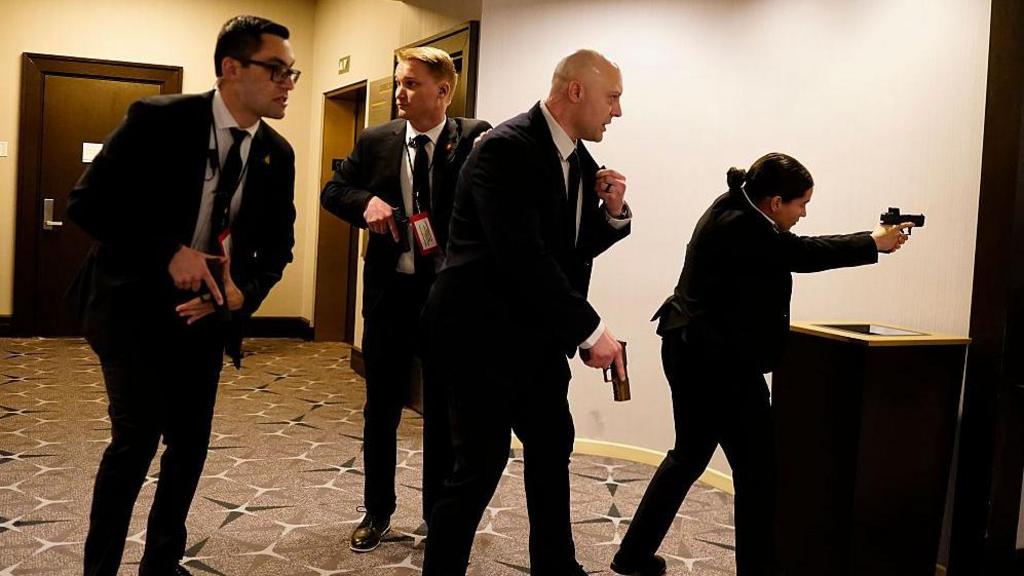
There is a peculiar cruelty in the timing. The White House Correspondents' Dinner—that annual carnival of self-congratulation where politicians and journalists briefly suspend their adversarial roles to toast one another—should occupy neutral ground. It exists in the margins of our political warfare, a night when the machinery of governance pauses to acknowledge the fourth estate that scrutinizes it. That a gunman sought to breach that sanctuary on Saturday evening suggests we have entered a phase where no margin remains safe from the heat of our divisions.
The facts themselves are relatively contained. The Secret Service responded with practiced efficiency. President Trump was evacuated without injury. A suspect is in custody. No one died. In the calculus of political violence in contemporary America, the evening might even be classified as a minor incident—a potential tragedy forestalled by the very security apparatus the suspect apparently sought to compromise. And yet something more unsettling than the violence itself ripples through the reporting and reactions: the immediate politicization of the event, the recriminations about who bears responsibility, the way that even attempted violence becomes another battleground rather than a shared moment of reckoning.
What strikes the careful observer is how the incident was absorbed into existing narratives within minutes of its occurrence. Representative Andy Ogles of Tennessee found time, while the ballroom was still being secured, to blame Democrats. Others questioned whether security protocols had been sufficiently rigorous. Still others seized on the moment to underscore Trump's resilience and law enforcement's competence. The event itself—designed to celebrate press freedom and institutional stability—became immediately weaponized, its meaning contested even as smoke still lingered.
The Erosion of Shared Ground
There exists a particular vulnerability to events like this, one that extends beyond the immediate threat. In previous eras, Americans managed to maintain certain zones of relative political detente. Inaugurals, funerals of presidents, moments of national trauma—these occasions permitted a temporary suspension of partisan calculations. They were spaces where the machinery of democracy could pause and acknowledge its own fragility.
The White House Correspondents' Dinner occupied such a space, however imperfectly. It celebrated the rough-and-tumble relationship between the press and power, but it did so with an understanding that both institutions depended upon the survival of democratic norms. The press needed government to permit speech; government needed the press to check its excesses. The dinner was theater, yes, but it was theater about something real—the stakes of an open society.
The shooting on Saturday suggests this sanctuary has evaporated. When a gunman targets the White House Correspondents' Dinner, he targets not merely a specific political figure but the very idea that such gatherings can occur safely. He targets the assumption that some spaces remain partly insulated from the violence that characterizes our fractured political moment. And the speed with which the incident became another point of contention—another opportunity to assign blame according to pre-existing tribal loyalties—suggests that we have lost even the capacity to grieve together in the immediate aftermath of violence.
This is not unprecedented in human history. Societies facing deep ideological ruptures have often found that even tragedies become occasions for renewed conflict. But it represents a particular loss in the American context, where the constitutional order has traditionally depended upon a minimum level of shared institutional respect. When the White House Correspondents' Dinner cannot be experienced as a moment of collective vulnerability but must immediately be parsed for political advantage, something essential has shifted.
The Weapon Factory of Modern Discourse
Deeper attention deserves to be paid to the ecosystem that produces such violence. The nation has witnessed an accelerating pattern: a person commits an act of political violence or attempted violence; observers immediately debate whether the perpetrator acted as an isolated extremist or as the logical extension of particular political rhetoric. The argument itself—the assignment of blame—becomes the story, overshadowing both the act and any genuine reckoning with how discourse produces deeds.
The emergence of figures like Taylor Budowich—a Trump aide offering business leaders advice on how to communicate with the president—provides an inadvertent window into how power operates in contemporary Washington. Budowich's counsel to "just tell him the truth" carries the implication that truth-telling is somehow difficult or countercultural in this administration, that business leaders arrive intimidated and feel compelled to dissemble. This small detail in a larger profile suggests an environment where the normal rules of institutional gravity have shifted. When advisers must coach executives on the simple virtue of honesty, the institutional fabric has become threadbare.
Yet this too becomes absorbed into the news cycle without adequate reflection. We move from one revelation to another—the dismissal of National Science Board members, the Iran negotiations, the depletion of missile stockpiles due to the February Iran conflict—without pausing to observe that these separate stories trace a common pattern. An administration governing by disruption, by purge, by the subordination of expertise to loyalty. These are not aberrations requiring individual explanation but expressions of a consistent approach. And in such an environment, where traditional sources of institutional authority have been deliberately corroded, the soil becomes more fertile for those who believe that violence rather than persuasion might alter the course of events.
The Cost of Constant Emergency
One overlooked dimension of Saturday's incident concerns the human cost of perpetual security theater. The White House Correspondents' Dinner was postponed and will be rescheduled within thirty days, Trump announced, to occur with even more security. But what does it mean for democratic culture when our most celebrated rituals of press freedom require military-grade protection? What does it mean when the ability to gather, celebrate, and critique requires not merely Secret Service presence but acceleration of security protocols to ever-higher levels of invasiveness?
There is a slow erosion that occurs when freedoms require constant defensive fortification. The press remains technically free to attend; the public remains theoretically permitted to know about the dinner's proceedings. But something intangible bleeds away when the simple act of gathering becomes a siege. Societies can survive occasional violence; what proves more corrosive is the steady ratcheting of security measures in response, until the very institutions we seek to protect become unrecognizable, surrounded by barriers, requiring credentials, monitored at every entrance.
The question is not whether safety matters—it manifestly does. Rather, it is whether we can acknowledge the price paid when safety itself becomes the preeminent value in a democratic society. When institutional leaders must prioritize the prevention of violence above the expression of dissent, the maintenance of order above the cultivation of genuine deliberation, something essential shifts. We have not yet become a fortress state, but Saturday's incident and its aftermath suggest we are moving in that direction.
The Necessity of Refusal
What remains required now is a kind of institutional stubbornness that contemporary American politics seems increasingly unwilling to provide. When violence occurs at democratic ceremonies, the appropriate response is not merely security enhancement but a reaffirmation of the ceremonies' purpose—the press's right to scrutinize power, to gather freely, to speak without prior restraint. These freedoms do carry risk. They require that we tolerate vulnerability.
The White House Correspondents' Dinner should return on schedule or ahead of schedule, not with enhanced barriers and expanded security perimeters, but with a clear statement about what it represents and why it matters. The press exists to afflict the comfortable and comfort the afflicted; sometimes that affliction provokes anger. That the anger occasionally turns violent does not invalidate the mission but rather confirms its necessity.
Saturday's shooting was a failure of security. But the greater threat to democratic institutions will not be occasional violence. It will be the steady accumulation of security measures undertaken in violence's name, until the very spaces designed to defend freedom become fortress-like, accessible only to the credentialed and protected, until the common experience of gathering, speaking, and listening—the raw material of democratic culture—becomes something approaching memory rather than lived reality.