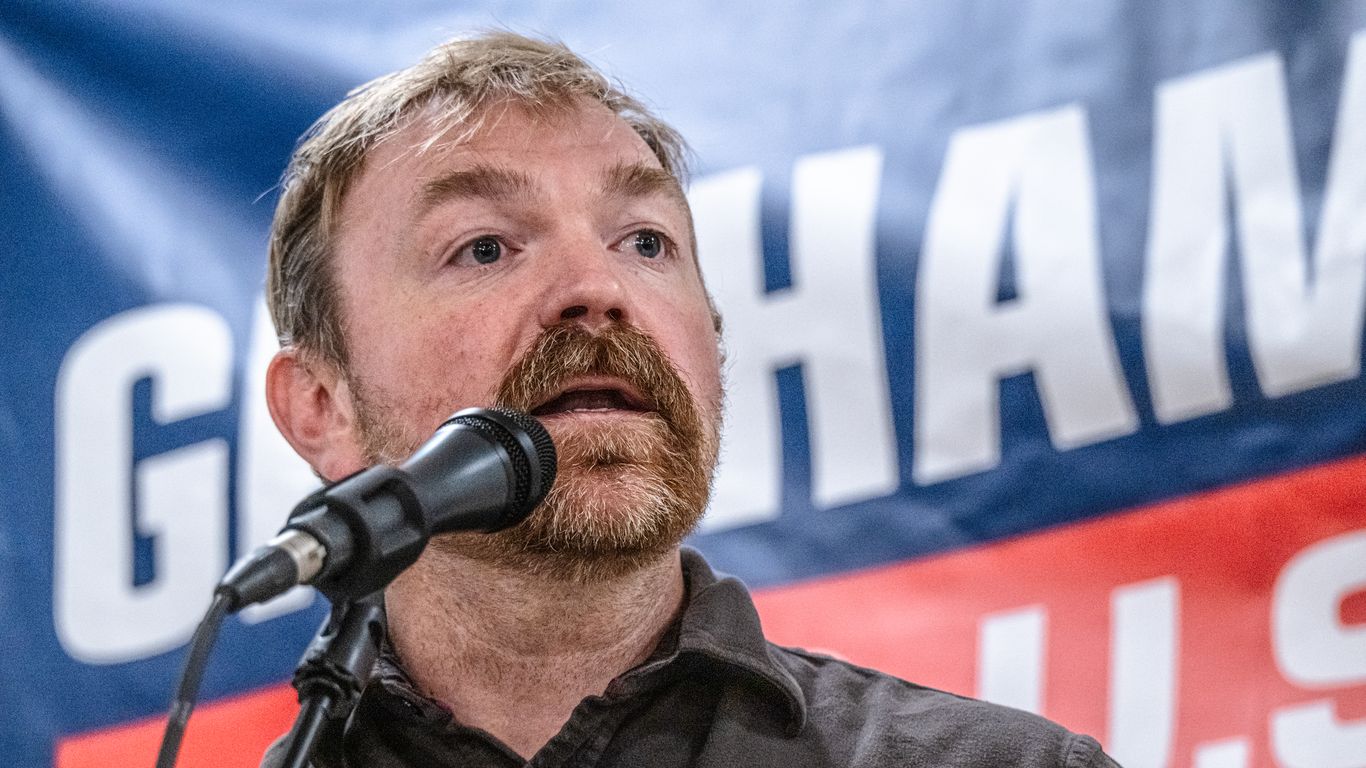
The Democratic Party's rank-and-file voters sent a curious message from Maine on Tuesday evening: they are willing to forgive almost anything in pursuit of political victory. Graham Platner, a scandal-plagued progressive with no prior political experience, won his party's Senate nomination handily, despite a Nazi-linked tattoo that required covering, allegations of infidelity conducted via text message, and social media posts in which he characterized rural white Americans as inherently "stupid and racist." The party's establishment tried to clear the field by recruiting Governor Janet Mills, who suspended her campaign when it became clear that Platner's insurgent appeal proved irresistible to Democratic voters. Now, as Platner prepares to face Senator Susan Collins—perhaps the most moderate Republican in Congress—the Democratic Party finds itself hostage to a choice its own voters made.
What occurred in Maine was not an aberration but rather a crystallization of a trend that has been building for years. The Democratic electorate has absorbed the lesson of the Trump presidency: that personal scandal, ethical lapses, and rhetorical excess no longer disqualify candidates from serious consideration. Where once such revelations would have created immediate pressure to withdraw from the race, Platner's controversies merely became talking points to be reframed as evidence of his authenticity or his willingness to acknowledge past mistakes. The calculation was straightforward and depressingly rational. If the opposition had normalized the unthinkable, why should the left handicap itself with outdated standards of personal conduct?
Yet there exists a categorical difference between accepting an imperfect candidate and embracing one whose documented history suggests troubling patterns of behavior toward women and whose youthful online rants betray views that sit uneasily alongside progressive rhetoric about equality and dignity. The Maine primary was less a vote for Platner than a vote against a political establishment perceived as insufficiently committed to challenging entrenched power. His promise to "topple the oligarchy" resonated precisely because it offered the appearance of existential commitment, even as his personal history raised serious questions about his character and judgment.
The Normalization of Scandal as Political Strategy
The paradox at the heart of Platner's victory is that it demonstrates both the strength and the weakness of democratic politics in an age of ideological polarization. Democratic voters in Maine were not ignorant of Platner's baggage. They knew about the tattoo. They knew about the sexual harassment allegations. They knew about the inflammatory Reddit posts. The Maine media had reported exhaustively on these matters. Yet voters made a conscious choice to proceed anyway, apparently reasoning that a progressive with problematic personal history remained preferable to any establishment figure, no matter how qualified.
This calculation reflects a hardening of tribal loyalties that should concern anyone invested in democratic governance. When voters are willing to overlook documented misconduct because the candidate advances their preferred policy agenda or embodies their desired political identity, they have crossed an important threshold. They have effectively announced that character, judgment, and personal integrity matter less than ideological alignment. They have voted, in essence, for the proposition that the ends justify the means—a principle that rarely produces good outcomes in democratic societies.
Complicating matters further is the observation that senior Democrats, including Senator Bernie Sanders and Representative Ro Khanna, have stood by Platner throughout his controversies. Some, like Senator Tina Smith, have actively defended him. This institutional embrace of a problematic candidate sends a message to Democratic voters that the party's leadership has accepted the new normal. Character matters less than victory. Norms are negotiable. The gloves are off.
A Senate Map That Demands Reckoning
What makes the Platner situation genuinely consequential is that Maine matters enormously to Democratic hopes for the Senate. The party faces a brutal map this cycle, with competitive races clustered in purple and red states where Democrats are fighting against demographic and structural headwinds. Susan Collins is the only Republican senator up for reelection in a state that favored Vice President Harris in 2024. For Democrats to retake the Senate, they likely must win in Maine. Which means that Platner's nomination has placed the party in a precarious position: he may be the only viable path to a crucial seat, even as his presence on the ticket creates genuine risks of electoral backlash.
Republicans have already begun the work of exploiting Platner's vulnerabilities, with pro-Collins super PACs airing advertisements about his controversial social media posts. The strategic calculation for the opposition is obvious and not without merit: highlight that Platner's disdain for rural Americans—a crucial Democratic constituency in some swing areas—reveals something essential about his character and judgment. There is no guarantee that Collins, a senator who has occasionally bucked her party and cultivated a reputation for pragmatism, will be vulnerable to a challenger whose campaign is built on ideological purity and whose personal conduct raises serious questions.
The cruel irony is that both major parties now appear willing to tolerate candidates of questionable character in pursuit of political advantage. The Republican Party normalized this trade-off years ago with Donald Trump. The Democratic Party, watching Republicans succeed despite Trump's well-documented misconduct, has concluded that it too must abandon its traditional emphasis on character and institutional rectitude. The result is not progress but rather a mutual degradation of democratic norms that benefits no one except those cynical enough to exploit public demoralization.
The Larger Story About Political Exhaustion
Beneath the Maine primary results lies a broader phenomenon worth examining: the American electorate appears to be experiencing a form of ethical exhaustion. After years of scandal and norm-breaking, voters across the political spectrum have stopped expecting their leaders to behave with basic decorum. The standards have eroded so completely that a candidate like Platner—whose personal history would have been instantly disqualifying even a decade ago—can win a major party nomination with relative ease. This is not a sign of democratic health but rather of democratic fatigue.
What goes largely unexamined in the mainstream coverage of the Maine race is the extent to which Platner's victory reflects not voter endorsement of his particular mix of policies and personal failings, but rather voter indifference born of hopelessness. When people stop believing that character matters in politics, they often stop believing that politics itself matters much. The result is a vicious cycle: declining faith in democratic institutions produces voters willing to support ethically compromised candidates, which further degrades public faith in those institutions. Platner's nomination is both a symptom and a cause of this deterioration.
Reckoning with Democracy's Bargain
The question facing Democrats now is whether they can actually win with a candidate whose documented history raises serious concerns about his judgment, his treatment of women, and his respect for the dignity of rural Americans. They may prevail in November anyway—Collins is, after all, a Republican in a state that has moved leftward. But any victory will come at a cost that extends beyond a single election cycle. It will represent a further normalization of the principle that personal character is negotiable when political stakes are sufficiently high.
Democracy depends, at some level, on shared assumptions about acceptable behavior and basic standards of integrity. When voters systematically ignore candidates' documented failings in service of tribal loyalty or ideological commitment, they are participating in the slow dissolution of those shared assumptions. The Platner primary was not a vote for change; it was a vote for the principle that standards no longer apply. That should trouble everyone who cares about the quality of democratic governance, regardless of party affiliation.