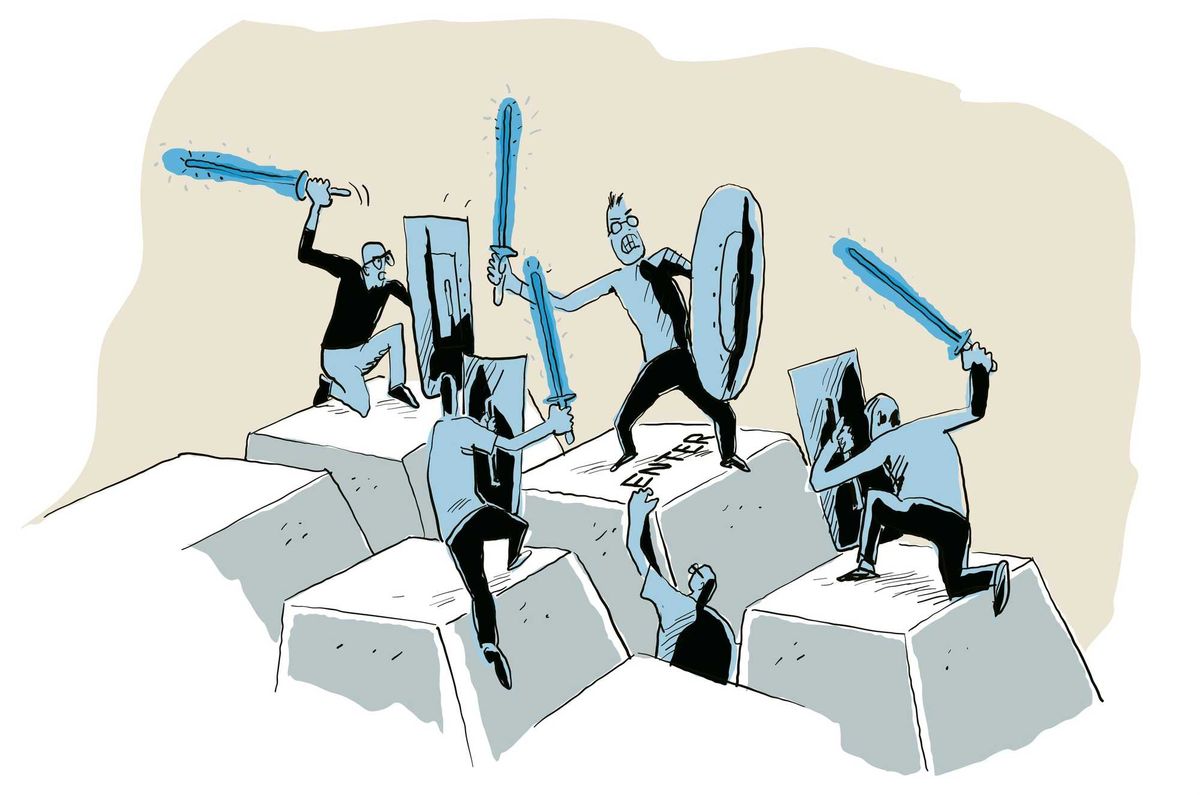
There is a particular exhaustion that settles over a democratic body when it realizes it can no longer agree on the basic terms of its own functioning. This week, as the House voted 324-92 against a war powers resolution on Lebanon, and as the Senate pushed through a reconciliation package over Democratic objections, Washington offered a masterclass in institutional deterioration. Not the kind that makes headlines—no grand constitutional crises or dramatic confrontations—but the slow, grinding erosion of shared assumptions about what Congress is supposed to do.
The irony cuts deep: even as lawmakers rejected constraints on executive war-making authority, federal inspectors were documenting systematic abuse at an ICE detention facility in Louisiana. Chokehold. Pen stabbing. Undocumented use of force. The same Congress that just deferred to presidential power in matters of foreign warfare had written laws it seemingly could not enforce against its own government's agents. The contradiction would be almost comical if the implications weren't so grave.
What we are witnessing is not the collision of opposing philosophies, but rather the breakdown of the procedural consensus that once held the institution together. Congress has become a place where the machinery still operates—votes are taken, bills are passed, committees meet—but where the fundamental agreement about why these things matter has fractured beyond easy repair.
The Lebanon Vote: Abdication Dressed as Pragmatism
The House's rejection of the Lebanon war powers resolution deserves more scrutiny than it received. On its surface, the vote appears straightforward: 324 representatives, including 207 Republicans and 117 Democrats, voted to allow the President to conduct military operations in Lebanon without explicit congressional authorization. A bipartisan majority, one might say. Democracy in action.
Except that framing obscures what actually happened. Rep. Rashida Tlaib, backed by progressive activists and co-sponsored by Rep. Delia Ramirez, forced a vote that her own party leadership actively undermined. Democratic moderates like Rep. Brad Schneider argued that U.S. forces in Lebanon were performing essential functions—protecting embassies, supporting the Lebanese Army against Hezbollah—as if these legitimate objectives somehow obviated the constitutional requirement for congressional authorization. The argument was not wrong, precisely, but it was incomplete. Democratic leadership could have provided alternative language, could have worked to accommodate moderate concerns while still asserting congressional prerogative. Instead, they allowed the resolution to be framed as a choice between supporting the troops and abdicating to the President.
The real story is what this reveals about contemporary Democratic strategy: a party so internally fractured on foreign policy that it cannot even muster sufficient unity to assert its constitutionally mandated role in authorizing warfare. Republicans, by contrast, presented near-total solidarity—with only Thomas Massie offering dissent—revealing how thoroughly Trump has disciplined the GOP caucus on matters of executive prerogative.
Congress has become a place where the machinery still operates, but the fundamental agreement about why these things matter has fractured beyond easy repair.
What makes this particularly troubling is the precedent it establishes. Each time Congress defers on war powers, it makes the next deferral easier. Each time it decides that the practical exigencies of the moment outweigh constitutional principle, it erodes the institutional memory of why those principles mattered in the first place.
The Detention Center Report: Where Laws Meet Lawlessness
Meanwhile, almost unnoticed beneath the Lebanon vote, came a Homeland Security Inspector General's report documenting systematic abuse at the Winn Correctional Center in Louisiana. An officer stabbed a detainee with a pen. Another used a prohibited chokehold. A third incident involving mechanical restraints and a suicide smock went undocumented. The facility was unsanitary, falling apart, with rotting food and structural decay.
The contrast with congressional action is almost too neat to be believed. The body that cannot muster sufficient will to authorize warfare also cannot enforce the laws it has written to protect detainees in its custody. The same Congress that deferred to the President on Lebanon had, at other moments, written detailed regulations for detention facilities. Yet here was evidence that those regulations were being systematically violated, with no clear mechanism for accountability or remediation.
What the inspector general's report demonstrates is that congressional power is not equally distributed across domains. When it comes to constraining the executive in matters of military might, Congress has become almost entirely deferential. But when it comes to protecting vulnerable populations—migrants, detainees, the powerless—Congress drafts elaborate rules and then lacks the sustained attention necessary to ensure they are followed. The result is a system where formal law and actual practice have diverged so completely that one hardly recognizes them as addressing the same reality.
The irony is not accidental. These detention facilities exist because Congress authorized immigration enforcement operations. These operations expanded because Congress kept voting for them, kept funding them, kept authorizing the executive to conduct them largely without oversight. Yet Congress seems genuinely surprised—or perhaps merely performatively concerned—when those operations produce exactly the kind of abuses one might predict from a system designed to maximize speed and minimize due process.
The Deeper Problem: Institutional Fracturing Beyond Policy
What unites these disparate stories is a loss of institutional coherence. It is not merely that Congress is divided on policy questions—that has always been true. Rather, Congress has ceased to function as a body with shared institutional interests. The legislature no longer consistently advocates for legislative prerogatives. Individual members and factions pursue narrow political objectives, and institutional concerns become secondary.
Consider the ongoing disputes over congressional redistricting, the Bill Pulte controversy at the DNI, the bitter floor confrontations over Lebanon. What emerges across these varied disputes is a Congress where no longer operates according to shared procedural expectations. When Rep. Max Miller called Rashida Tlaib a sympathizer with Hezbollah and then doubled down on the assertion, he was not merely making a political point. He was violating the understanding that colleagues do not question each other's basic loyalty or patriotism. When party leadership tries to suppress votes rather than win them, they are abandoning the belief that Congress should settle its differences through deliberation and voting.
This fracturing has real consequences. The detention center abuses went unaddressed not because Congress lacks legal authority to act, but because the institution has become too fractured to sustain the kind of consistent oversight that reform would require. The Lebanon war powers vote was lost not because the resolution's substantive claims were weak, but because Congress can no longer act as a unified deliberative body even on matters of constitutional gravity.
Toward Institutional Restoration
What would restoration require? Certainly not consensus on policy—that is neither possible nor necessary in a democracy. Rather, what would be required is a restoration of the understanding that congressional prerogatives matter, that institutional health is a prerequisite for democratic governance, and that some questions should transcend partisan calculation.
The detainees at Winn Correctional Center did not become vulnerable because of partisanship or ideology. They became vulnerable because Congress wrote rules it could not enforce, created an agency it could not control, and gradually ceased to regard oversight as part of its essential function. The troops in Lebanon will remain in country not because an overwhelming majority of Americans or Congress supports that deployment, but because Congress has gradually surrendered the assumption that it should have a say in such matters.
These are not failures of principle, though they are that. They are failures of institutional will. And until Congress recovers some sense that it is an institution with its own stakes and its own survival to protect, such failures will only proliferate.