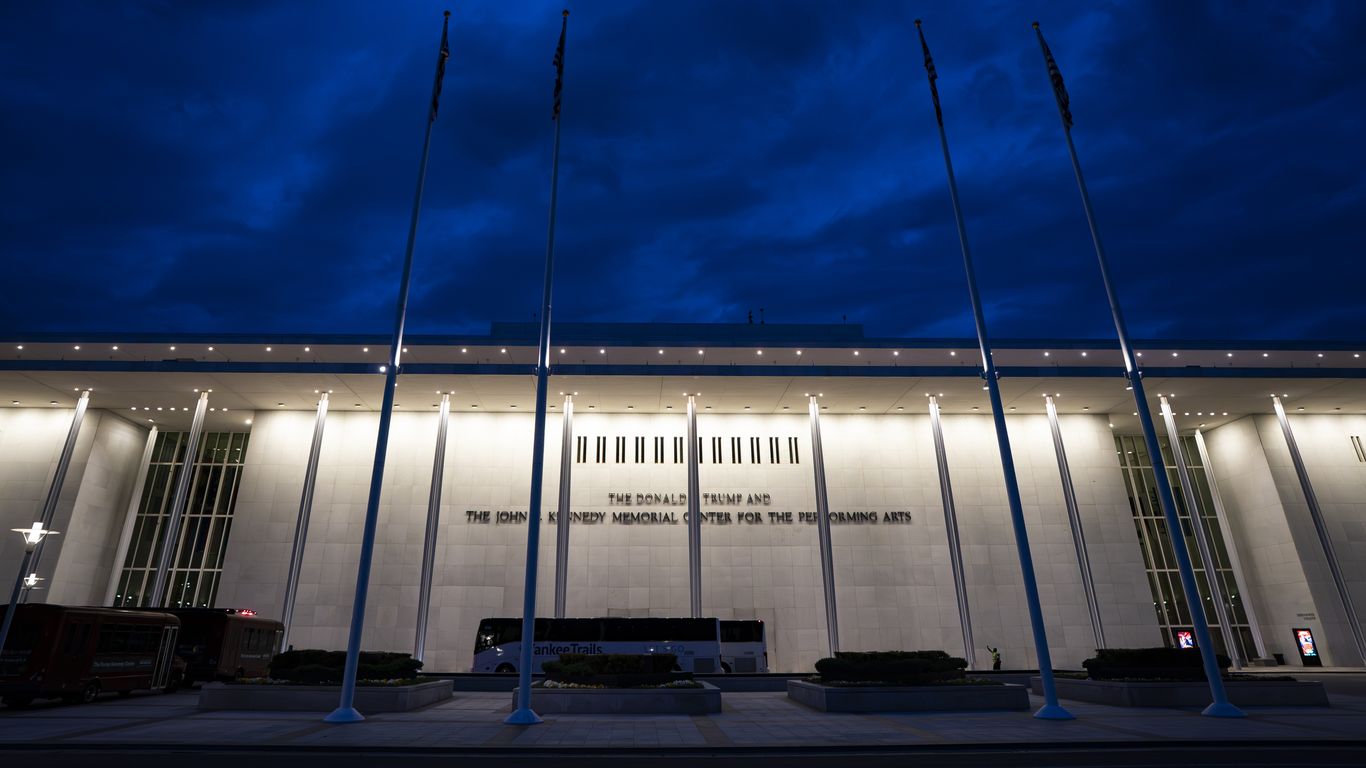
Something has shifted in the American conversation about power, and it became visible this week not in any single headline but in the texture of several. A federal judge ordered the removal of President Trump's name from the Kennedy Center, invoking the plain language of a 1964 Congressional statute. Simultaneously, the administration's new Homeland Security Secretary Markwayne Mullin doubled down on harsh immigration enforcement at a New Jersey detention facility, dismissing concerns about hunger strikes and inhumane conditions. A congressman from Maine faces revelations about sexually explicit messages. A retiring congresswoman explains her strategic silence about a decision already made. A meteorite fell somewhere over New England. And yet beneath the apparent chaos lies something worth examining with care: the question of whether democratic institutions can actually constrain power, or whether they merely create the appearance of doing so.
Judge Christopher Cooper's ruling on the Kennedy Center represents the judiciary at its most necessary function—a check against executive overreach dressed in the language of institutional honor. The court's conclusion that only Congress can rename a building that Congress itself named in 1964 seems almost laughably obvious until one considers that we live in a moment when such obviousness requires ninety-four pages of judicial reasoning to enforce. Trump dismissed board members and appointed his allies, who then voted to rename the building after him. The process was technically lawful in its mechanics; the outcome violated something deeper than law—the spirit of public stewardship. Cooper's order halts the renovation project and requires the name's removal within two weeks. This is judicial power operating at the margins, enforcing the text when political power has wandered into the gray zones of institutional capture.
Yet even as courts reassert these boundaries, another story unfolds that suggests the boundaries may be narrowing elsewhere. At Delaney Hall, the detention facility in Newark that has become the symbol of Trump's second-term immigration enforcement, Secretary Mullin faces his first major test. Reports indicate a coordinated hunger strike by some three hundred detainees, yet DHS denies the hunger strike exists, attributing refusals to eat to ethnic food preferences. When Governor Mikie Sherrill of New Jersey sought health inspections, the facility restricted access to food service inspections only. The administration appears to have learned from its predecessor's downfall—Kristi Noem was pushed out after deadly incidents and escalating backlash—and has adopted a strategy of aggressive denialism. Mullin, barely two months into the job, is establishing that the department will not acknowledge what protesters, advocates, and elected officials claim to witness. This is not the Kennedy Center moment. This is power operating without judicial or Congressional constraint, in a domain where federal authority is nearly absolute and visibility is limited.
The Kennedy Center Paradox
The Kennedy Center ruling deserves more attention than it has received because it exposes something fundamental about the Trump administration's relationship to institutional legitimacy. The president possesses genuine authority to appoint board members, to advocate for renovations, to reshape the direction of federal institutions. What he lacked was the authority to rename a building defined by statute. The line between what he can do and what he cannot is written in law, yet the question of whether that line will be respected depends entirely on whether anyone chooses to enforce it.
Trump responded to the ruling by blasting the judge and threatening to walk away from the renovation project entirely. In his nearly six-hundred-word Truth Social manifesto, he reframed his forced name removal as evidence of persecution, suggesting that unless he is "free to do what I do better than anyone else," he has no interest in continuing. This is a masterful rhetorical move: transform a legal constraint into a personal affront, then present withdrawal as wounded dignity rather than compliance. What matters is not whether the strategy works on Trump himself, but whether it works on his political base and future judges. If courts become understood as obstacles rather than arbiters, their authority erodes through accumulated delegitimation.
The Kennedy Center case will likely proceed to appeal, where the administration will have an opportunity to argue that the board's actions, while perhaps unwise, fall within executive discretion. A sympathetic appellate court might find creative language to permit the renaming while superficially respecting Congressional intent. Or courts might hold firm. The outcome matters less, perhaps, than what the struggle itself reveals: that even straightforward legal questions now provoke bitter institutional combat.
Immigration and the Limits of Oversight
The Delaney Hall detention center presents a starkly different problem. Here, the Trump administration operates within the broad discretion that immigration law grants the executive branch. No statute forbids harsh detention conditions. No Congressional action prevents the facility's operation. Courts are slow to intervene in immigration matters, particularly when detention is framed as a temporary measure on the path to deportation. Secretary Mullin's denialism about hunger strikes is not illegal; it is strategic communication designed to prevent the stories of detainees from achieving sufficient visibility to trigger political pressure.
Governor Sherrill's announcement of a "protected protest zone" and her determination to facilitate health inspections represents the response available to states: bureaucratic persistence, moral witness, and the hope that sustained attention generates political cost. It is a fragile tool. Democratic lawmakers have called for the facility's closure, but they control neither the executive nor (effectively) the Senate. New Jersey's governor can facilitate inspections but cannot mandate them if federal officials refuse access. Civil rights organizations can document conditions, but documentation requires the kind of access that federal officials control.
What distinguishes the Delaney Hall situation from the Kennedy Center case is the absence of a clear legal violation. The Kennedy Center has an actual name written into statute; Delaney Hall's conditions are governed by vague standards about what constitutes humane treatment. When law provides clear boundaries, courts can enforce them. When law provides discretion, courts defer to the executive, and the question of constraint becomes entirely political.
The Invisible Architecture of Institutional Decay
Elsewhere in this week's news, smaller stories hint at a broader erosion. Rep. Frederica Wilson's retirement announcement, delayed until after she had publically denied it, reveals how even straightforward decisions become entangled with strategic calculations about redistricting and power dynamics. She withheld the truth from her constituents and publicly denied reality, all for tactical advantage. It is a minor instance of the larger phenomenon: when institutional trust erodes, even routine decisions become exercises in information management.
The allegation against Maine Senate candidate Graham Platner—that his wife informed campaign staff of sexually explicit messages he had sent to other women—illustrates how institutional silence enables misconduct. Platner's campaign apparently continued without addressing the matter directly. The story only became public when journalists investigated, suggesting that institutional mechanisms for accountability had already failed.
These are not scandals that will shake the presidency. They are the mundane failures through which democracies deteriorate. When candidates can strategically withhold information about their own retirement. When campaigns can quietly manage allegations of infidelity. When detention facilities can deny conditions that protesters and elected officials attest to witnessing. When denial becomes the default strategy rather than transparency the norm—these are the moments through which democratic institutions lose their binding power.
Toward Harder Questions
The question this week's events pose is not whether the Trump administration is uniquely threatening to democracy. Rather, it is whether American institutions can constrain power across the full spectrum of governance, or whether they can only do so in narrow domains where law is clear and visibility is high. The Kennedy Center case is winnable in court because statutes speak clearly. Delaney Hall is nearly invulnerable to legal challenge because immigration law grants broad discretion. Most governance happens in the spaces between these extremes, where power operates through strategic silence, denied hunger strikes, withheld announcements, and the slow accumulation of small compromises.
Federal judges can order names removed from buildings. But they cannot easily order honesty about detention conditions, transparency about campaign misconduct, or truthfulness from elected officials about their own plans. The architecture of constraint depends on political culture, on the assumption that officials will respect norms and accept limits, on the belief that democracy functions because people choose to make it work. Once that choice becomes optional, courts become a backup system—important but insufficient.
That is the deeper story this week tells, not in the dramatic confrontation between Trump and a federal judge, but in the quiet calculus by which institutional power is exercised beyond public view.