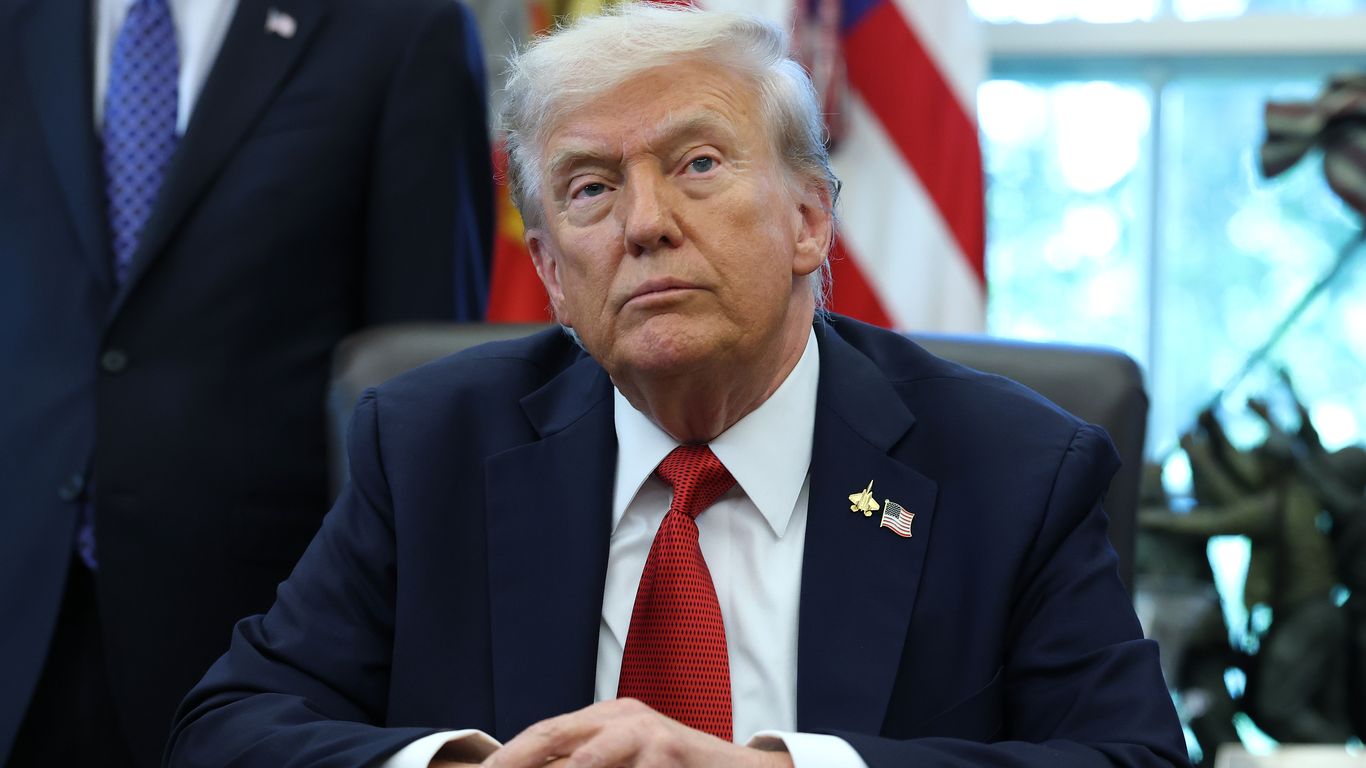
We live in an age of provisional truces. What was supposed to be announced yesterday—a historic memorandum of understanding between the United States and Iran—remains unsigned, caught in that peculiar limbo where diplomatic triumph and catastrophic failure feel equally plausible. President Trump, characterizing the odds as "solid 50/50" between "a good deal" and bombing Iran "to kingdom come," has given us perhaps the most honest assessment of where American statecraft stands in May 2026: balanced on the knife's edge between reasoned restraint and apocalyptic escalation.
The details emerging from the negotiations paint a picture of genuine compromise, at least on its surface. A sixty-day ceasefire. The Strait of Hormuz reopened without tolls. Iranian sanctions waivers allowing oil sales. A commitment to negotiate—not to immediately resolve—the nuclear question. In exchange, the United States would lift its blockade and, in the measured phrase of one official, maintain its principle of "relief for performance." It is the architecture of a deal that sensible people might construct when faced with the alternative.
Yet sensible construction does not guarantee sensible execution. The coverage of these negotiations reveals, more plainly than any policy paper could, the deep fissures running through the Trump administration itself and through the Republican Party's foreign policy establishment.
The Gap Between Diplomacy and Domestic Reality
Consider the remarkable coalition that has emerged in support of the Iran deal: the leaders of Saudi Arabia, the United Arab Emirates, Egypt, Qatar, Turkey, and Pakistan—a roster of regional powers with otherwise divergent interests—all urging Trump to take the agreement. One regional source captured their collective sentiment with brutal economy: "Please stop the war for the benefit of the whole region." This is not poetry. This is desperation from actors who understand that the Strait of Hormuz is not merely a waterway but the economic lifeline of their own nations.
Yet set against this regional consensus is the resistance from within Trump's own political coalition. Senator Lindsey Graham, the president's longtime confidant, expressed his skepticism in language that reveals the depth of the divide. Graham articulates the argument of the skeptics—that Iran cannot be trusted, that the deal is a capitulation, that strength is the only language Tehran understands. But notice what he does not do: he does not pretend the consequences of another round of massive strikes are unclear. "If Iran is attacked it has the ability to destroy substantial Gulf oil operations," he acknowledges, before pivoting to hope that somehow American overwhelming force will render Iran unable to respond.
This gap between what regional leaders know—that the region needs this deal—and what American hawks believe—that surrender disguises itself as compromise—is the real story the press has been circling without quite naming. The coverage dutifully reports Netanyahu's "concern" (a word that sanitizes his opposition), frames Trump as wavering (a narrative that obscures his actual consistency in keeping both options available), and quotes officials without adequately reckoning with what their contradictions reveal about the fragility of the moment.
What the news accounts have largely missed is this: the deal, should it be signed, will not succeed or fail on its merits as written. It will succeed or fail based on whether the parties genuinely believe they have incentives to maintain it. For Iran, that incentive is economic desperation—the regime needs sanctions relief the way a drowning man needs air. For the United States, the incentive should be the preservation of global economic stability and the avoidance of another Middle Eastern entanglement. The problem is that Trump's own advisers—Witkoff, Kushner, and others—do not appear to be equally convinced they share those incentives with the administration that will follow them.
Silicon Valley's Bet Against Tomorrow
While the fate of empires hangs in the balance in South Asia, Wall Street has made a remarkably uncomplicated choice about the future: artificial intelligence is the only story that matters. Hedge funds are doubling down on AI stocks. Chipmakers have emerged as the biggest bet. The market has spoken, and it has spoken with stunning unanimity about one thing: compute power, distributed globally, will be more valuable than oil moving through the Strait of Hormuz.
This is not necessarily wrong. It is, however, magnificently poorly-timed. We are watching an administration negotiate to stabilize the world's most critical energy chokepoint while investors pour capital into technologies whose electricity demands may render such stability irrelevant within a decade. There is something almost absurdist about the moment—as if we are rearranging the furniture on a ship whose course has already been plotted toward transformation.
The White House's reported effort to force its official app onto all government employee phones—a story delivered with snark and skepticism by the press—deserves to be understood as something more than a marketing ploy. It represents something closer to an anxiety attack, a recognition that in an age of AI and algorithmic authority, the relationship between institutions and citizens has fundamentally changed. You cannot ban an algorithm from a smartphone. You can only hope your algorithm gets downloaded more often than the competing algorithms.
The 2028 Question Nobody Wants to Ask
Alexandria Ocasio-Cortez is crisscrossing the country. She is speaking at historic Black churches. She is meeting with the families of civil rights icons. She is careful to frame her ambitions as ideological rather than positional, yet the positioning is unmistakable. Democratic operatives note that she could raise a hundred million dollars in small donations. They note that she commands attention that few others could. They note these things the way chess players note that a particular piece is positioned near the center of the board.
The coverage of AOC's nascent presidential ambitions treats it as genuine news. And it is. But what it also is—what the press has not quite articulated—is a referendum on where the Democratic Party believes it must go if it wishes to govern. Does it move toward the coalition-building represented by regional leaders convinced that compromise preserves prosperity? Or does it move toward the moral clarity represented by a new generation convinced that incremental change is insufficient? The same question, posed in different registers, that is being asked by the Trump administration as it decides between a sixty-day ceasefire and strategic annihilation.
The Provisional Character of Our Moment
We have become creatures of the provisional. A sixty-day ceasefire. An announcement "shortly." A decision "by Sunday." Even in matters of highest consequence, we operate as though nothing need be permanent. This is partly a reflection of genuine uncertainty—no one can be certain Iran will honor the deal or that the nuclear issue can be resolved. But it is also, perhaps, a reflection of a deeper exhaustion. We can no longer imagine futures. We can only imagine the next sixty days.
The news of the day arrives in discrete units of information, each treated as though it exists in isolation from the others: the Iran deal, the AI boom, the 2028 primary, the coal mine explosion in China, the robot making meals in San Francisco's Tenderloin. The press dutifully reports each in turn, offering context where context can be found. But the connective tissue—the way these stories speak to a civilization in transition, uncertain of its direction, hedging all bets—remains largely unarticulated.
This briefing exists to suggest that connective tissue. We are watching an administration try to prevent catastrophe in the Middle East while the financial system bets everything on a technological transformation that may render the Middle East's oil irrelevant. We are watching a new generation of politicians position themselves for power by questioning whether the old frameworks for exercising it remain valid. We are watching, in short, the collision between the world as it has been and the world as it might become—with no clear victor yet in sight.