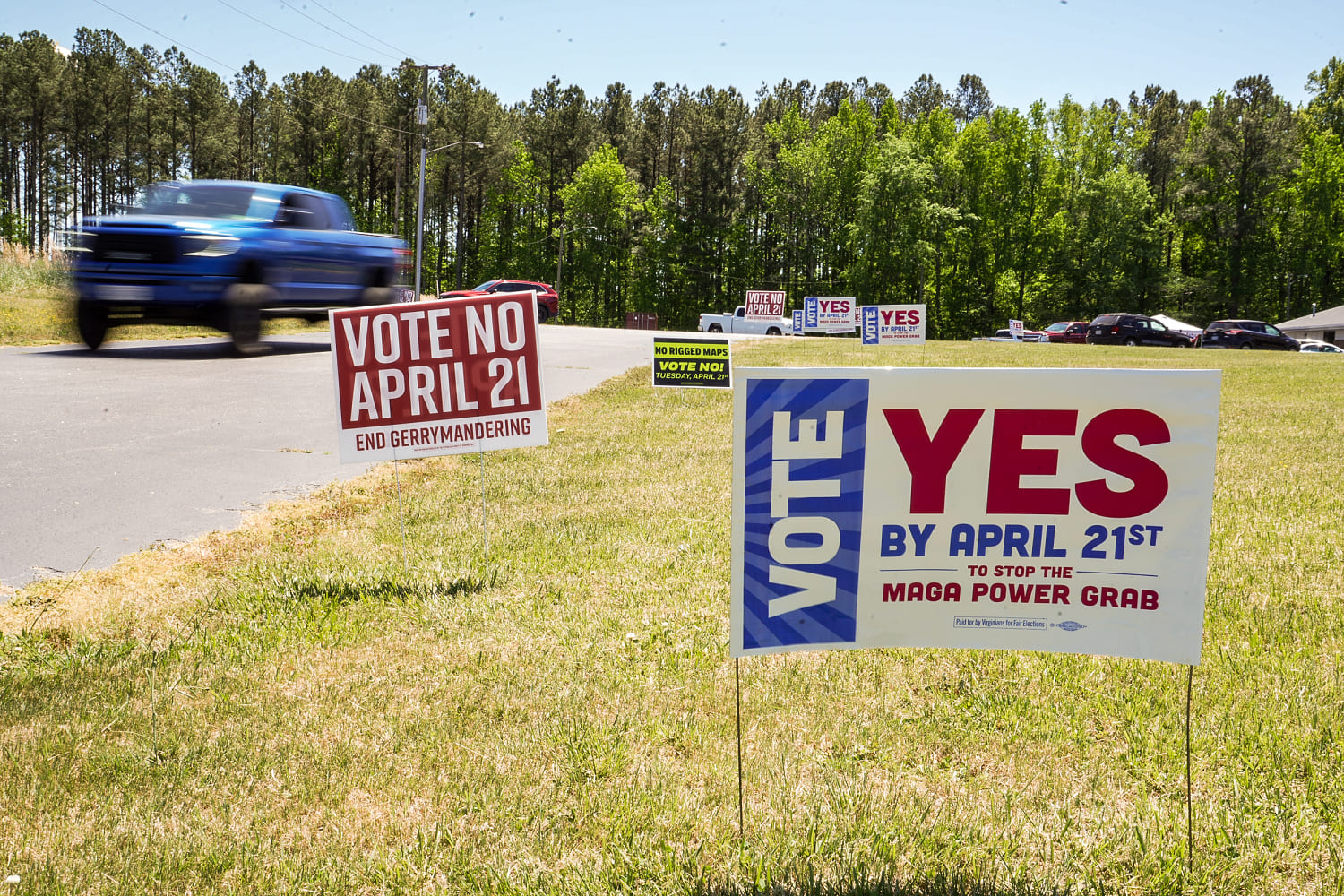
There is something peculiarly modern about the crisis unfolding across American courts this week. Not the substance of the disputes—gerrymandering has haunted our republic since the word was coined in 1812—but the exposure of how little consensus exists about who should draw electoral lines and by what authority. Virginia Democrats have asked the Supreme Court to validate a congressional map that their own state Supreme Court deemed the product of an unlawful process. Meanwhile, in South Carolina, President Trump exhorts Republicans to match Tennessee's boldness in redistricting, a cheerleading that transforms what should be a technical legislative matter into a national political spectacle. These scenes lay bare a foundational anxiety: we no longer agree on what legitimate democratic process looks like.
The Virginia case cuts to the heart of the contradiction. A state Supreme Court ruled that the referendum process approving a new map violated state law. Yet Democrats, even those who should theoretically support judicial review and procedural integrity, now ask the nation's highest court to override that state court's judgment. This is not a simple story about partisan villainy. It reflects instead a deeper desperation: when every tool has been weaponized, when both sides understand that map-drawing determines electoral outcomes for a decade, the procedural niceties that once governed these disputes become luxuries no one can afford. The irony is bitter. We have arrived at a moment where the parties most committed to democratic principles feel compelled to circumvent democratic procedures to protect what they believe democracy requires.
Trump's intervention in South Carolina reveals something equally troubling: the nationalization of what were once local decisions. When a president of the United States publicly urges state legislators to be "bold and courageous" in a redistricting vote, he is not simply expressing a preference. He is signaling that partisan advantage at the national level matters more than local democratic deliberation. The reference to Tennessee—where Republicans just approved a map threatening the state's only House Democrat—is not subtle. It is an explicit endorsement of aggressive partisan cartography. This is democracy in the language of warfare, with victory conditions measured in safely Republican seats.
The Abortion Stay and the Court's Uncertain Hand
While redistricting captures the political headlines, the Supreme Court's continued extension of the abortion pill freeze speaks to a different constitutional crisis unfolding in real time. Justice Alito extended a temporary pause on restrictions through Thursday—a modest reprieve that nonetheless reveals the extraordinary pressure the judiciary faces on this question. The stay came after the Fifth Circuit Court of Appeals sided with Louisiana's argument that expanded access to mifepristone somehow violated the state's interest in protecting "unborn human life" and unnecessarily burdened state Medicaid spending.
What deserves scrutiny here is not merely the substantive abortion question, though that remains profound, but rather the mechanism by which these decisions are being made. A temporary stay that must be renewed suggests a court unsure of its own footing, issuing decisions that read as delaying tactics rather than principled rulings. The fact that Louisiana claims harm through state expenditures on emergency care—a theory that would grant states standing to regulate federal medical policy whenever they can document tangential fiscal consequences—represents an expansive reimagining of state sovereignty that should alarm Americans across the political spectrum. Yet it attracts little attention compared to the redistricting wars, perhaps because the temporary stays create the illusion that the matter remains undecided, that time exists for negotiations that will almost certainly never come.
The Pentagon's Risky Theater and the Iran Question
Buried in the day's news is an item that warrants far more careful analysis than it has received: the Pentagon's disclosure of a nuclear-armed submarine's location in Gibraltar, announced immediately after Trump rejected Iran's latest peace proposal. The stated rationale—that the port visit "demonstrates" American strength and commitment to the region—rings hollow. The real message is considerably darker: we are signaling military escalation at a moment when diplomatic channels have just closed.
This act reveals a disturbing pattern in contemporary statecraft. Military posturing has become a substitute for negotiation. The disclosure itself is unusual enough to merit serious attention; it suggests either desperate signaling or a troubling comfort with nuclear brinkmanship as routine diplomatic language. Meanwhile, oil prices rise as the Iran war drags on—language that normalizes what remains an extraordinarily consequential regional conflict. The markets absorb this as just another variable in the pricing equation. American stocks inch toward records. The human and strategic costs of indefinite conflict become abstractions, footnotes in financial reporting.
The Overlooked Conversation About Expertise and Trust
Among the headlines that merit deeper reflection is the BBC investigation into baby-sleep advice that contradicts NHS guidelines. This story might appear to concern only parents and pediatricians, but it illuminates something far more significant: the crisis of expertise and institutional authority in contemporary society. The existence of "sleep experts" operating outside official guidelines is not new, but the BBC's investigation brings into focus a world in which institutional guidance has become just another option in a marketplace of competing claims. Parents must navigate not guidelines from trusted authorities but a proliferation of competing advice, each backed by credentials, testimonials, and the apparatus of expertise.
This atomization of authority mirrors what we see in our political and constitutional debates. We no longer have shared sources of truth about how democracy should function, who should draw maps, or what constitutes legitimate expertise. Everyone possesses credentials. Everyone can marshal evidence. The BBC investigation succeeded because it offered something increasingly rare: a judgment about which voices deserve trust. Yet in our fractured landscape, even that investigation will be dismissed by those invested in the alternative narratives. Trust cannot be reconstructed through exposure; it must be rebuilt through institutions that demonstrate sustained commitment to truth over advantage.
The Unmapped Territory Ahead
What emerges from this collection of stories is not a series of discrete policy problems but a portrait of a system losing its procedural consensus. The courts extend stays rather than decide. Politicians stage public performances rather than negotiate in earnest. Experts proliferate outside institutional frameworks. Military signals replace diplomatic overtures. The maps that determine representation are drawn by those who benefit from the outcome.
None of this is inevitable. But it suggests that fixing American democracy requires confronting not individual policies or even discrete constitutional questions, but rather the underlying crisis of institutional legitimacy that animates all of these disputes. We need not merely better maps or clearer abortion policy. We need to rebuild the shared understanding that certain institutions—courts, electoral bodies, expert agencies—deserve deference not because they are infallible but because they operate according to procedures we collectively recognize as legitimate. Without that foundation, every decision becomes a battle, and every battle seems to demand victory at any cost.