The staggering cost of winning a Senate seat in 2026
Source: www.axios.com ·
Section: politics ·
Bias: Center
· Published: Thu, 08 Oct 2026 21:00:01 GMT
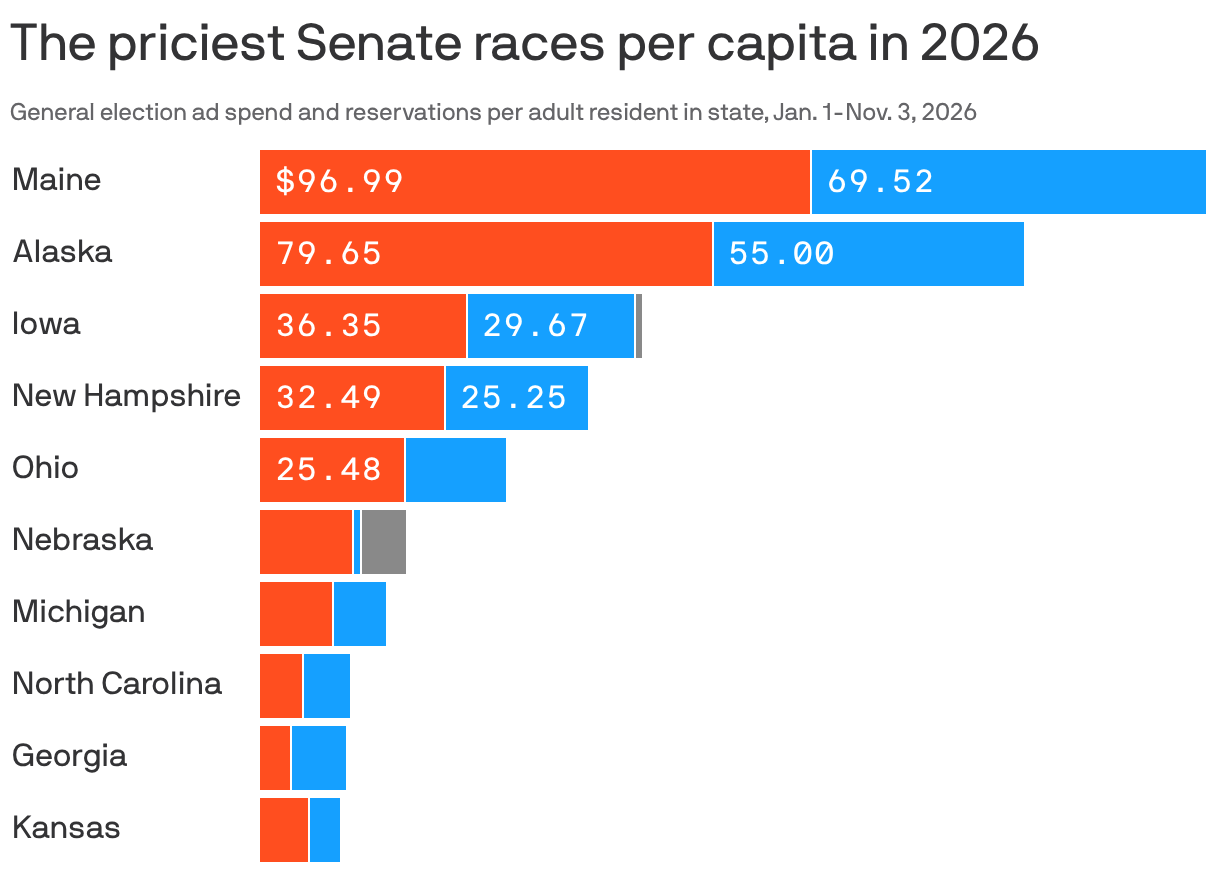
Source: AdImpact, Census.gov Note: AdImpact data includes dollars spent on video advertisements on broadcast, cable and social media as well as spending estimates on streaming platforms. Chart: Stef Kight/AxiosEvery voting-age Mainer could get a $167 voucher for home heating oil with what Democrats and Republicans are spending on ads in the Senate race, according to an analysis of AdImpact data.Why it matters: Every senator gets one vote, but Senate seats aren't created equal — and they don't cost the same. Zoom in: Like two years ago, the less-populated states have a dramatically higher dollar-per-voter ratio in 2026.Maine is in first place, followed by Alaska, which is scheduled to be hit with $76 million in ads — enough to suck up most of the state's inventory.Between the lines: Ohio is only in fifth place on the dollar-per-voter metric, but it's on track to host the most expensive Senate race in the country — for the second cycle in a row. Sherrod Brown's comeback bid is proving more expensive than his 2024 race, when he was ousted by now-Sen. Bernie Moreno (R-Ohio).And in New Hampshire, where Democratic Senate nominee Chris Pappas has been warning that his race is actually quite close, both parties are spending heavily to reach the state's voters.Data: AdImpact Note: AdImpact data includes dollars spent on video advertisements on broadcast, cable and social media as well as spending estimates on streaming platforms. Chart: Stef Kight/AxiosThe big picture: Both chambers are likely to come down to a handful of races.All year, Republicans warned that Texas would get really expensive if Attorney General Ken Paxton won the primary. They were right.Outside GOP groups spent a mind-blowing $131 million in just 17 days trying to rescue Paxton. And tens of millions more could be on the way.But in North Carolina, where Sen. Tim Scott (R-S.C.), chair of the National Republican Senatorial Committee (NRSC), predicted the race could cost $1 billion, the contest looks like it will come in under $200 million.Republican super PACs are abandoning the Senate race there as they reallocate money to redder states.The bottom line: Republicans have a spending advantage, especially when it comes to how many eyeballs they're actually reaching in Texas and Ohio.But neither side has really figured out how to play moneyball and find a way to reach voters with a dramatically smaller budget.
Read the full article at www.axios.com →
The same story across the political spectrum (15 sources)
← Back to FlashTopics.com